
➤ What the bill does: (i) Imposes a new toll on northbound or southbound vehicles crossing 60th St. in Manhattan, including where 60th St. would cross FDR Drive (if it extended east to the East River) and Route 9A (if it extended west to the Hudson River). Revenue will go to a special Move NY Mobility Fund (Topic 2.1) to pay for public transit and other transportation infrastructure improvements (Topic 3).
Read the legislative language: V.T.L. §§ 1701(5); 1702(1); 1703(1), 1703(2).
(ii) Sets the toll amount according to tolls charged for the Queens Midtown or Brooklyn Battery Tunnels but tells NYC-DOT to devise a variable, demand-based pricing schedule, so that actual tolls are higher at peak times and lower off-peak. This variable schedule must raise at least as much money, overall, as would be raised if the tolls were a constant price.
Read the legislative language: V.T.L. §§ 1701(5); 1703(2), 1703(10).
(iii) Directs that tolls be collected electronically (e.g., EZ Pass system) or by mail based on license-plate camera recordings. Cash can't be used, to avoid toll plaza slowdowns. Electronic toll rates will be much cheaper than tolls billed by mail.
Read the legislative language: V.T.L. §§ 1701(3), 1701(9); 1703(1), 1703(9).
(iv) Imposes tolls on all vehicles and vehicle classes with the following exceptions:
- Taxis and other for-hire vehicles (FHVs) that pay the surcharge described in subtopic 3 below are exempt from the tolls.
- Other commercial vehicles would pay for only one round-trip per 24-hour period, no matter how often they cross the tolled perimeter, so long as they are equipped with a commercial EZ Pass.
- Emergency vehicles and NYC government vehicles are exempt if the newly created Move NY Highway & Transit Authority (see Topic 4.1) sets these exemptions by rulemaking.
Read the legislative language: V.T.L. §§ 1703(7)(d), 1703(8).
(v) Conditions the new tolls on TBTA reducing tolls on the 7 MTA bridges (subtopic 2), and withdraws NYSDOT's authority to continue perimeter tolling if TBTA doesn't maintain the required reduction;
Read the legislative language: V.T.L. §§ 1703(4), 1703(5), 1703(6).
➤ Rationale: The most recent traffic census (PDF Table 23A) shows that over 735,000 private vehicles enter the Manhattan hub every workday, for nearly 1.5 million total entries and exits. According to NYC-DOT, average traffic speed has decreased to about 8.5 mph. According to the NYC Comptroller (PDF), New Yorkers have the longest commuting time of any large U.S. city. Researchers calculate that the average NYC area commuter wastes 53 hours a year in congestion delays, and one study (PDF) estimates that congestion costs NYC about $16 billion a year in productive time lost during commuting. Also, this much traffic increases pollution and accidents, interferes with emergency vehicles, and slows public transit.
The predicted effects of the new tolls are 100,000 fewer auto trips daily into the congested area below 60th St., with average traffic speed increasing 15%-20%. The new revenue will be used to improve public transit and other transportation infrastructure (see Topics 2 and 3), which the City and State have been struggling to find the money for.





Comments45
Commenting is now closed.
Nick
March 24, 2016 - 6:10pm
The toll cordon zone must extend into the FDR and West Side Highway to reduce the incentive for drivers to utilize them for circumnavigation, adding to pollution in densely populated communites. Currently, many drivers jam up Bronx highways and local streets to utilize the free Third Ave/Willis Ave Bridges in an attempt to dodge tolls on the Tri-boro and Henry Hudson bridges and access the FDR/West Side Highway. This excess congestion creates a dangerous situation where collisions are commonplace, pollution has reached dangerous levels, and the populations most affected are also the most socioeconomically vulnerable. These drivers should utilize higher capacity options and avoid the core of the city entirely.
A variable tolling scheme is most effective at discouraging driving into the city's core. The costs to enter via automobile should be most expensive during times of peak congestion, high levels of air pollution and emergency situations. An app and online website could keep up to date information on the current cost along with recently implemented digital signage along highways.
Moderator
March 26, 2016 - 12:56pm
Hello, Nick, thank you for sharing your thoughts. You mentioned the toll zone should extend into the FDR and the West Side Hwy (9A). If I understand you correctly, you agree with this part of the proposed bill.
The 60th St. toll border does extend into the FDR and West Side Hwy where 60th St. would cross those routes if 60th St. extended to the east and west edges of the island (see "What the bill does: (i)," in the pane to the left).
With few exceptions, if someone is south of 60th St. in a car, they paid a toll to get there and they'll pay a toll to get out, including if they came in or out on the FDR or the West Side Hwy. How do you feel about the proposed toll collection system (i.e., ez pass or by mail only--no cash)?
Nick
March 28, 2016 - 9:47pm
Thank you for the clarification. The first paragraph reads as though it may extend to the Hudson River, not that it will.
And yes I support a cordon extending from river to river.EZPass does make sense. Might as well use a common form of payment in the metropolitan area, as does camera enforcement with higher fees for those without transponders. This system will be far cheaper to set up than what is currently implemented in London.
TomRider
April 23, 2016 - 2:32pm
Dedicated commercial truck lanes would be help. Maybe you could charge a premium toll for use of the dedicated commercial lane.
Moderator
April 27, 2016 - 4:58pm
Welcome to the discussion and thank you for your comment, TomRider. The bill uses a reverse strategy of charging all vehicles, but giving a break to commercial vehicles that make multiple trips. Supporters think this will eventually reduce the number of vehicles without too great a burden on delivery and service providers. What do you think of this strategy?
DriverofTrucks
April 24, 2016 - 12:26pm
If the purpose is to reduce traffic, then a part of this plan should be to enforce double parking and require full payment of parking tickets from everyone. No more negotiations to reduce the cost of all the parking tickets that big trucking and delivery companies get for themselves.
Moderator
April 25, 2016 - 2:51pm
Welcome DriverofTrucks, in Topic 3.4 of the online discussion that happened before this bill was introduced, a lot of people complained about how existing traffic laws are enforced, but no one made this exact point. The bill itself doesn’t do anything about enforcement. Do you think the state legislature should tell NYC how to enforce its parking laws, or is this something that people should complain about directly to City officials?
cferrejo
April 26, 2016 - 5:35pm
We do not need new tolls. Tax and spend is driving the middle class working family out of NYC. Its time to manage. Mange MTA costs of public transportation and construction projects. Like the Eastside access project. Forcast at 1.6 billion; now approaching 10 billion to complete. Its almost criminal.!! What are you doing about this.!! Raise tolls.???
Moderator
April 27, 2016 - 4:56pm
Welcome back, cferrejo. The new money is supposed to go road and bridge repair and to community transportation needs, as well as to big MTA projects, but MTA costs have definitely gotten a lot of attention. Do you have suggestions for what the legislature in Albany should do about this?
cferrejo
April 30, 2016 - 7:25pm
Albany has not demonstrated any ability or desire to control costs. Its so easy to raise tolls and say its for bridge and road repair. The public just goes along with it.No questions asked. There are no metric to measure;no funding details with time lines. Just spend the money. These next so called transportation funds have already been raised in the form of tolls and taxes. Unfortunately those funds have been mismanaged so they say they need more. The public needs 100% transparency. Albany should present on-line a full MTA expenditure summery and budget with metrics of cost and funding; every quarter. Where do the billions go.??? Let the public investigate and figure out a solution. N.Y.S. politicians are useless...
Nick
April 29, 2016 - 9:58pm
Most New Yorkers (including the middle class) do not drive into the Manhattan CBD district on a regular basis.The middle class instead suffers from slow buses, pollution, and increased prevalence of collisions due to congestion.Tolls would reduce congestion in the core and along all paths into the core.
Moderator
May 2, 2016 - 1:40am
Hello Nick great to hear from you again. I understand you support the proposed tolls. What do you think about the way the proposed plan would toll e-hail services and commercial vehicles? E-hail vehicles would be subject to the surcharge (in lieu of tolls) described in Topic 1.3 and commercial vehicles would only pay once in each direction within a 24 hour period.
cferrejo
May 10, 2016 - 6:43pm
Manhattan is only one of the five boro's and yes we absolutely have to drive from Queens or Brooklyn to Long Island daily. Increasing tolls only funds and facilitates MTA waste ,fraud and corruption. High tolls on trucking only increases the cost of goods; sold like food. The tolls should be reduced.
John Maier
May 10, 2016 - 2:55pm
A car is a personal choice that has so many impacts on those around you and an extensive network of social costs. To say that you shouldn't share in the cost of your decision is to pass the costs of your personal choices onto the larger public. What is really criminal is that I'm subsidizing your use of an automobile that is one of the greatest sources of carbon emissions in this country, occupies the majority of our road space-both in travel and in parking, all while giving me no benefit. Please start paying your fare share!
Nick
May 10, 2016 - 8:18pm
Agreed@John Maler.
And cferrejo, the MoveNY plan does not impact drivers traveling to Brooklyn or Long Island from Queens. In fact, outer tolls would decrease in price, for example between Queens and the Bronx via the Throgs Neck Bridge. The new tolls would only affect drivers traveling into the Manhattan Central Busines District.Additionally, congestion pricing in other cities has not led to an increase in the cost of goods. In fact, deliveries are expedited thanks to reduced automotive traffic which saves businesses money.
Mary Caulfield
June 7, 2016 - 8:34pm
When the public cares enough about my safety to provide a guarantee against further sexual assaults, I will go back to taking the train. As it stands, after 25 years and dozens of offensives I changed careers so I could drive to work, pay for my own parking and drive home. I have not been assaulted since then. Don't you dare call me criminal again! Calling people who drive lazy, wasteful or selfish makes you look like a self-righteous jerk. You don't know what you are talking about.
Ihavecars
April 27, 2016 - 10:03am
I'm actually a bit glad for this bill. I'm so sick of Manhattan, and charging me money to drive my car into it--into a place that I personally pay for--has just driven me over the edge (no pun intended). I'll not go or pay for worthless place again.
Moderator
April 27, 2016 - 4:14pm
Welcome to the discussion, ihavecars. Sounds like cost of driving into Manhattan is your number one concern. Do you think congestion is big issue? If so, what would your suggestions be on how to reduce it?
cferrejo
May 11, 2016 - 6:51pm
Reduce congestion by cutting the number of taxi's and Uber cars unleashed in the last several years. Cut congestion by having traffic engineers take a reasonable look at the timing of street lights and adding turning signals. No one wants to here it but when a combustion engine runs at 10-20 mph the pollution is 60% higher than when it runs at 30-35 mph and the more run hours a car runs on the street due to deliberate efforts to stall traffic the polution increases accordingly. Just take a look at the numbers with traffic flow.
Nick
April 29, 2016 - 9:59pm
Take the subway or just pay the toll.
FreeTrucks
April 27, 2016 - 10:38am
I'm going to have to agree with some of the other folks here who say we should just fix what we already have, not make something new. You want to help NYC finances and transportation, then just fix the agencies we have. Don't make another that we'll just have to fix again in ten years. Or that we'll never fix and will just add to the burden. It's not so hard to deal with NYC traffic. Give trucks special lanes. Enforce parking violations. And make the trains and busses run on time and make them safe. That alone would fix so much of our problem, without new agencies. Maybe you'll need to increase tolls, sure. I don't like it but I get it. But you don't need more bureaucrats. They're the problem, not the solution.
Moderator
April 27, 2016 - 4:25pm
Welcome to the discussion FreeTrucks9. Others in the discussion have agreed with your opposition to a new agency (MNYHTA) because they thought it was unnecessary.
Under the proposed bill, the MNYHTA would disburse funds—limited to specified transportation investments only to three different transportation agencies (MTA, TBTA, NYC-DOT (see Topic 3.1) and would be subject to transparency measures (for example, annual public reports on disbursements; see Topic 4.1).
What alternative would you offer to people who feel that creating the MNYHTA is needed to make sure it stays outside the regular Albany budget process and gets directly to transportation purposes?
HaanCenter
May 1, 2016 - 3:49pm
New agencies will always make people nervous. Why not just repurpose and existing agency? Give it a new charter, etc. Wouldn't that have the same effect but without the political discomfort of creating a whole new agency? I'm sure there is at least one agency in the state that isn't doing much and could use something to justify it's existence.
ericamukh
May 4, 2016 - 2:19pm
I fully support the efforts to increase tolls into Manhattan while simultaneously lowering the toll burden of the outer boroughs. Before moving to Brooklyn, we lived in Far Rockaway, a part of Queens that is difficult to access without a car. However, I had to be very thoughtful of when I could afford to use my car as I had to go over the Cross Bay Bridge, and subsequently pay a toll, anytime I wanted to drive to the rest of Queens, a borough with a comparatively less dense public transport network.
I think it is important that people who live in places were driving is more of a necessity have limited impediments to do so, whereas people who live in work in Manhattan take advantage of the myriad of transportation links on the island.
At the same time, it is crucial to the continued development of NYC that public transportation density be expanded so that cars are not as necessary in the outer boroughs.
Moderator
May 4, 2016 - 3:43pm
Hello, ericamukh, thank you for joining in. You make an interesting point. If I understand correctly, you have a car, live in Brooklyn, and originally hail from Queens, and also feel that the bill's toll reform effort will benefit you as a driver in the boroughs.
Supporters of the bill feel that the toll reform element will reduce traffic congestion, raise funds for improved transit, and also make driving in the City more equitable.
Do you have any hypothetical examples of how a Brooklyn-to-midtown commuter or maybe a Queens to Brooklyn commuter, for example, will be better off in her daily commute under the proposed toll reform?
ericamukh
May 13, 2016 - 2:15pm
Moderator, hypothetically I imagine that the proposed toll system would speed up express buses. I imagine that if I had to drive into midtown from Brooklyn (as I did several times when I helped out with jewelry sales at a street fair and needed a van to transport the merchandise) it would be easier to find parking for said van. Hypothetically, I would imagine that it would be an easier choice to drive out to the Rockaways for a summer day on the beach.
Overall, my support of this proposal stems from the idea that when one has to drive one should not be penalized, but when public transit options are readily available one should use them first. A proposal that helps to fund public transit improvements while decreasing the cost of driving in areas without easily available transit links has my support.
John Maier
May 10, 2016 - 3:17pm
We need to reclaim the streets of our city, the free river crossing on the 59th street bridge has taken away the streets of LIC and Sunnyside, and the impacts can be felt as far away as Maspeth, Woodside, and Astoria.
The logic of this proposal is well structured and honest, but it might need to provide some assistance for neighborhoods in Queens near transit stops where people will inclined to treat as their new park and ride lot while taking a train or express bus to Manhattan. Residential parking permits would help people that live in these communities, and could also start to reflect the true cost of free parking in this city.
Moderator
May 16, 2016 - 11:44am
Thank you for your comment, John Maier. Can you think of any means the state gov't could use to implement protections on your concern about unauthorized Queens park and rides?
oils21
May 11, 2016 - 9:45am
I am against the 60th St. toll as there is a potential for Bronx residents to be tolled twice if they try to drive into Manhattan. As a lifelong NYC resident, the outer boroughs have always played second fiddle to Manhattan and this adds to the impression that only Manhattan counts. I have 2 small children and most Sundays, we drive into Manhattan for a family day which includes us getting lunch or dinner. That trip now becomes much more expensive if I have to pay 2 tolls.
Which brings me to my other issues with this. Why do drivers going North at 60th street have to pay toll since they are leaving the area.? Also, if this is implemented, the tolls should only apply during working hours on weekdays.
Finally, trying to get more money out of non-Manhattan NYC residents should only be attempted after trying to get more out of those who chose to leave NYC but work in it. This means bringing back the commuter tax on suburban residents. This could help fund some of these services that this plan intends to.
There are too many flaws in this for me to support and I am a person who lives a green lifestyle and takes mass transit most days and rides my bike for most of my errands. It just seems another Manhattan centric policy at the expense of the rest of the city, which is poorer. Manhattan should not be a gated community.
jarod213
May 12, 2016 - 11:20am
The plan prevents you from being tolled twice. Please read the bill. You are tolled a maximum amount in a 24-hour period.
Moderator
May 18, 2016 - 1:20pm
Hello, jarod213, thank you for your comments. Actually, I believe the one-round-trip-24-hour toll limitation is an exception that applies to commercial vehicles, only. The summary in the window pane to the right notes this in point (iv)(1), about halfway down the summary. Does that change your view of the bill at all?
jarod213
May 18, 2016 - 1:37pm
Moderator, no it does not change my view/opinion.
Moderator
May 16, 2016 - 11:38am
Hello, oils21, thank you for joining the discussion. Because the plan uses a demand-based variable pricing structure, Sunday tolling would be significantly reduced, compared to mid-week tolls.
Tolling to get into and then out of the tolling area is to prevent gaming the tolls. Keep in mind that the toll-in is a bit like paying one-half of the overall toll. The toll-out is a bit like paying the other half of the overall toll.
That said, I see your point and your concern. Do you have any alternatives in mind that could achieve the same attempted goals as the bill while better meeting your needs?
oils21
May 17, 2016 - 11:07am
Are tolls going to be half the cost they are now so I pay half coming in and half going out? I did not get that impression. Plus I am not sure how one games the toll at this point? If I want to avoid it, I cant go into Queens since I still have to use the Triborough to get back,.
Anyway, I think a compromise on this is to have the plan only apply on weekdays between 8am and 6pm and no tolls leaving the area since one leaving helps solve the issue by reducing congestion. I agree that weekday congestion is horrible and needs to be addressed (I never drive in on weekdays as I subway to work every day) but, honestly, my weekend drives in with my small children are not that bad. I am able to park easily. I don't think my right to come into Manhattan is any less valid than those living there wanting to have emptier streets. Keep in mind the 6 train runs local in the Bronx weekends so a mass transit trip is way longer (unless MoveNY wants to recommend express service in the Bronx on weekends as well).
Finally, I think this should also be looked at after consideration is given to bringing back the commuter tax for non-NYC residents who work in NYC but live outside.
Moderator
May 18, 2016 - 12:43pm
Hello, again, oils21. Thank you for putting forth an alternative measure. It's helpful--particularly your point about having no tolls to leave the tolled area may incentive less traffic within the tolled area south of 60th.
As to your question, the tolls won't be half of what they are now. What I was attempting to convey was that the thought process for the new toll system is that you'd essentially be paying half of the new toll as you enter the tolled area and paying half as you leave the tolled area.
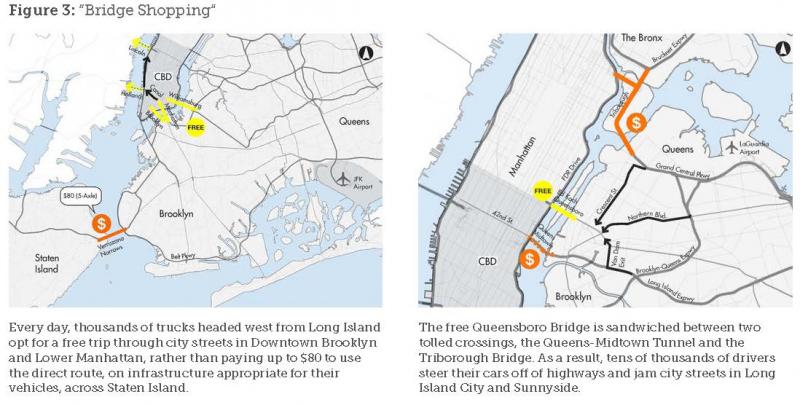
From Topic 2.2--Here's a map showing the current toll system (i.e., what thruways are currently tolled) versus the proposed new toll system with proposed dollar amounts. How do you feel about these actual proposed dollar amounts, keeping in mind that they don't reflect likely decreases for low demand periods--like Sundays?
jarod213
May 12, 2016 - 11:10am
The MoveNY legislation is an absolute necessity. It is the best plan on the table and there are no other plans that achieve as much in the way of traffic normalization, equity, increased revenue for transit, increased revenue for road infrastructure, and rationalized transportation patterns. However, we need to support better cross-Hudson rail/ferry access to NYC markets. Housing prices are imbalanced across the reason mainly due to unequal access to rail transit to NYC jobs. We must increase access to Rockland County by expanding Haverstraw-Ossining Ferry service and by restoring the West Shore Railroad passenger service from Haverstraw to Secaucus and ultimately to Penn Station New York. https://www.change.org/p/boost-the-economy-expand-the-ferry
Quinn Raymond
May 12, 2016 - 4:50pm
The status quo-- (subsidizing traffic over the East River crossings) make no sense at all. The proposal is basic common sense to anyone willing to study it.When I do choose to drive, I would much prefer to not be stuck in traffic. When I don't choose to drive, I would prefer that other drivers pay for what they use, and car-pool when possible.
Quinn Raymond
May 12, 2016 - 4:53pm
Related specifically to part 1-- 60th street is obviously a good cut-off point due to Central Park and the Queensboro bridge.
Stephen
May 13, 2016 - 9:47am
Private cars and driving is a privilege, not a right. Too long have we turned our streets over for the exclusive movement of vehicles instead of people. This plan does not ban private cars (which one could make a decent argument for), instead, the plan gives recognizes that there is not enough supply of roadway to meet demand, and that creating more roadway for cars has far too high of cost to people, the built environment, and the ecosystem. It quantifies, in economic terms, the scarcity of space for each persons' car to get into Manhattan CBD and reflects *some* of the social and environmental costs of deciding to drive into the most densely settled area in the country, rather than utilizing active transportation or our world-class transit system. Further, it recognizes that there isn't great service everywhere in the city - which can be a burden on lower middle class families that have to live farther away from good transit, but can afford a car - by directing the proceeds of the shift in tolls/new tolls to transit investments and expansion.
Is it a perfect plan? Of course not. Will all of us have to continue to engage with policy makers to ensure that the money is spent equitably (i.e. transit expansion in poorer and underserved areas)? Of course. But, this is a massive step toward prioritizing moving people, instead of vehicles. As well as recognizing the roles transit, for hire vehicles, efficient commercial deliveries, active transportation, and intelligent parking policy have in making a vibrant, equitable, thriving, and people-centered city.
DrewG
May 13, 2016 - 10:48am
While I have a vested self interest as a daily bike commuter in reducing the number of cars in Manhattan (as well as other boros), a toll such a the one proposed is essentially a regressive form of taxation that will disproportionately affect middle- and lower-income people who need to drive into Manhattan. There are already so many economic factors that are creating real hardships for non-wealthy New Yorkers, and this would simply add to the problems of economic inequality that plague our city.
Moderator
May 16, 2016 - 8:07am
Thank you, DrewG, for your nuanced and helpful comment. Another commenter has expressed a concern similar to your concern for the effect the new tolling system might have on those who are less financially privileged.
Assuming that traffic congestion in Manhattan and transit funding has gotten so bad that something must be done, could you think of a reasonable alternative that would accomplish the bill's goals and also better serve the whole of NYC?
DrewG
May 16, 2016 - 12:31pm
The one thing that comes to mind is reducing the number of rides originating within the affected area. I don't have figures to cite in this regard, but based on 30+ years of observation, taxi and car service rides (now with uber) represent a very significant volume of traffic that is, in my opinion, the least necessary (barring age/disability) as these areas are the best served by public transportation and are largely very walkable and have access to CitiBike.
One can see the necessity of driving into Manhattan for deliveries or to perform services that require some amount of equipment that can't reasonably be carried on the subway, etc. I would be more likely to favor the banning of all traffic that doesn't fall into one of these categories. The need to commute by car simply to avoid taking public transport is practically nil (again, barring age/disability and taking into account areas that are underserved by the MTA).
The current proposals present no actual disincentive to those individuals who may already fall into the category of commuting via car service/uber in order to avoid the subway; the highest priced neighborhoods in Brooklyn and Queens are very well served by public transport, but those who can afford to live in these areas would be the least affected by paying tolls.
Nick
May 17, 2016 - 4:52am
"“…The truth is that just 5 percent of commuters in Brooklyn, Queens,Staten Island and the Bronx travel to Manhattan by private car. Peoplewho drive their cars to work also earn 30 percent more a year than thoseof us who use mass transit. It is our poor and middle-class families whowould benefit from congestion pricing—as the fees charged to driverswould be used to improve the bus and subway system. ""Of all New York City residentswhocommute to work, only 5 percent drive to theCBD. Of that 5 percent, most (80 percent) have afeasible transit alternative to get to work that wouldtake no more than 15 minutes longer than theirauto trip. Therefore, only 1 percent of Manhattanworkers lack a viable alternative to paying a congestionfee or toll. The low- and moderate-incomeworkers disproportionately impacted by a fee or atoll represent a further subgroup within this 1 percent.Legislation that was proposed for considerationby the State legislature would have providedtax credits to compensate low-income motorists foramounts that they would have to pay in excess ofthe round-trip transit fare
A large number of low- and moderate-income residents would benefit from improved transit services under any of the three revenue-generating plans: As a group, low- and moderate-income New York City residents rely more on transit for their travel needs when compared with higher income residents. Therefore, these low- and moderate-income residents would benefit more from the shortterm transit enhancements that would precede a toll or fee imposition and from the expansion of the transit system made possible by increased revenues for transit investment."
http://ops.fhwa.dot.gov/publications/fhwahop08040/fhwahop08040.pdf
jerlbaum
May 18, 2016 - 6:45pm
We can and should exempt or heavily discount scooters and motorbikes from these tolls.We should be encouraging people who must travel by motor vehicle to do so using these smaller vehicles. Powered two-wheelers ("PTWs") take 1/6th of the space while parked, and 1/6th of the space on the roadway. An *average* PTW gets 40-80 mpg!If we don't exempt PTWs from these new tolls (or at least match the current EZpass 50% discount) are we encouraging people to take their much-larger cars or trucks, instead of a small, fuel-efficient PTW.The London congestion pricing system (on which MoveNY is based) exempts PTWs from ALL fees. We should follow their lead in this regard, too.
Nick
May 20, 2016 - 1:10am
Agreed, motorcycles and scooters should get a discount.